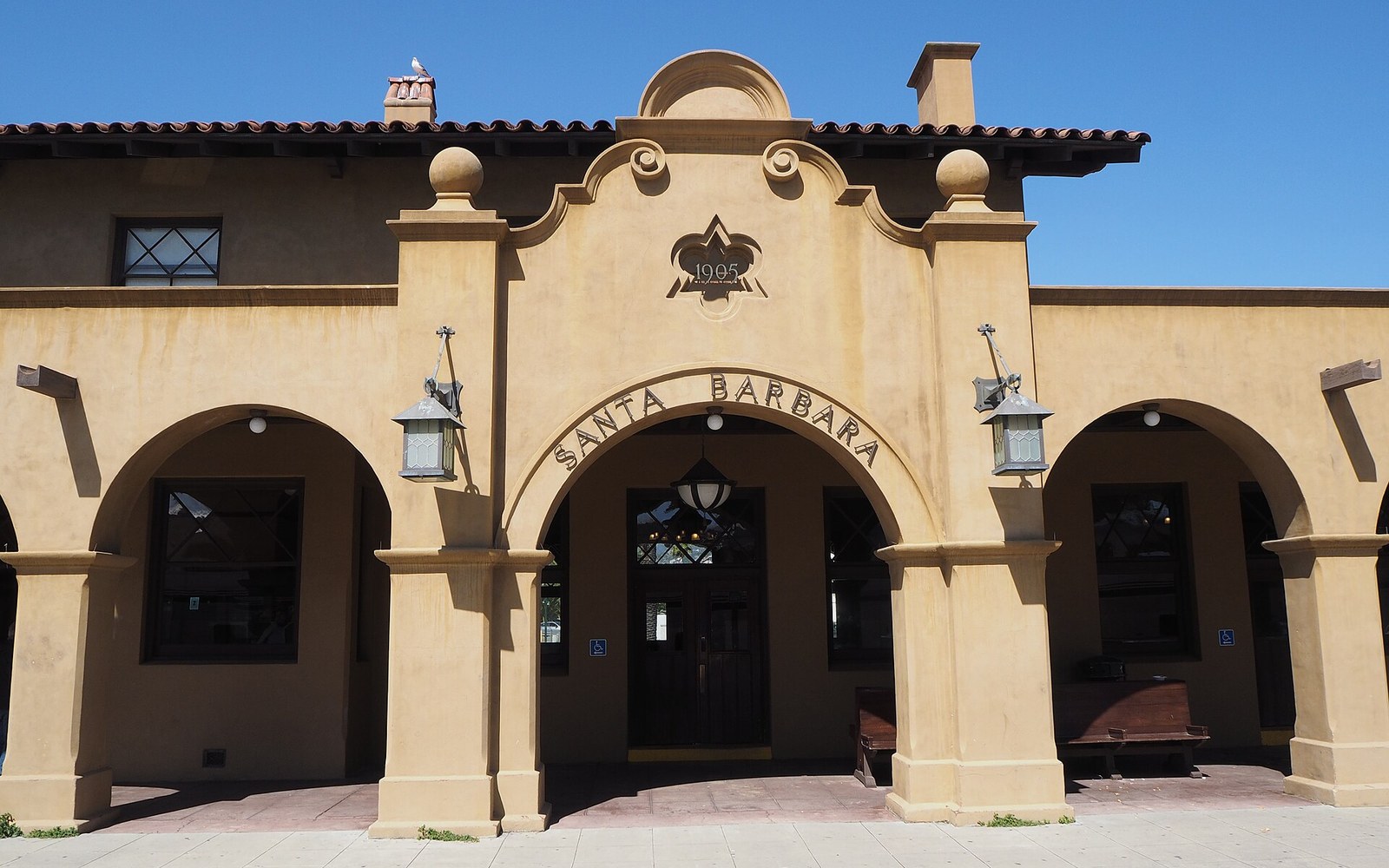
The train does the math better than most operators want to admit.
The Corridor in Numbers
The Pacific Surfliner runs between San Luis Obispo and San Diego, stopping at Santa Barbara's station on Chapala Street before threading the coast through Ventura and down to Los Angeles Union Station. Amtrak's published timetable shows the Santa Barbara–Los Angeles segment at roughly two hours and thirty minutes on a good day — meaning no freight conflicts, no signal delays along the Union Pacific right-of-way. Fares vary by booking date and seat class, but a coach ticket purchased in advance regularly falls below thirty dollars each way; a business-class seat runs somewhat higher but remains well under a hundred dollars.
For a party of two, the round-trip cost in coach sits in the sixty-to-eighty-dollar range. Door-to-door, however, the math shifts. The Amtrak station is not most passengers' origin, and Union Station is not most passengers' destination. Add a rideshare or taxi from a Montecito or Summerland address to the Chapala Street platform — and a second one at the Los Angeles end — and the price climbs by forty to seventy dollars each way before a bag is lifted onto the overhead rack.
Where the Sedan Closes the Gap
A TCP-permitted sedan, priced as point-to-point transport under California Public Utilities Commission charter-party rules, eliminates both transfer legs. The vehicle departs from the passenger's address and arrives at theirs. On a corridor where the client base skews toward wine-country estates and Montecito residences set well back from any transit stop, that single fact is decisive for a significant share of bookings.
Journey time tells a more complicated story. Caltrans highway performance data places US 101 southbound from Santa Barbara into central Los Angeles — accounting for typical mid-morning traffic — at two hours and forty-five minutes to three hours and fifteen minutes, sometimes more. The Surfliner, when on time, beats that. When it is not on time, the gap narrows. The on-time performance statistics maintained by the Federal Railroad Administration show the Pacific Surfliner corridor averaging roughly seventy to seventy-five percent on-time in recent reporting periods, meaning roughly one in four journeys overruns its schedule.
The calculus the industry actually uses is simpler: a party of two traveling with luggage to a non-central destination, on a schedule set by the client rather than a timetable, is rarely a Surfliner booking. A solo traveler with a laptop and flexibility often is. Neither side of this equation is changing soon, which is why operators along the 101 corridor treat the Surfliner as a known variable rather than an existential threat — priced in, not panicked over.