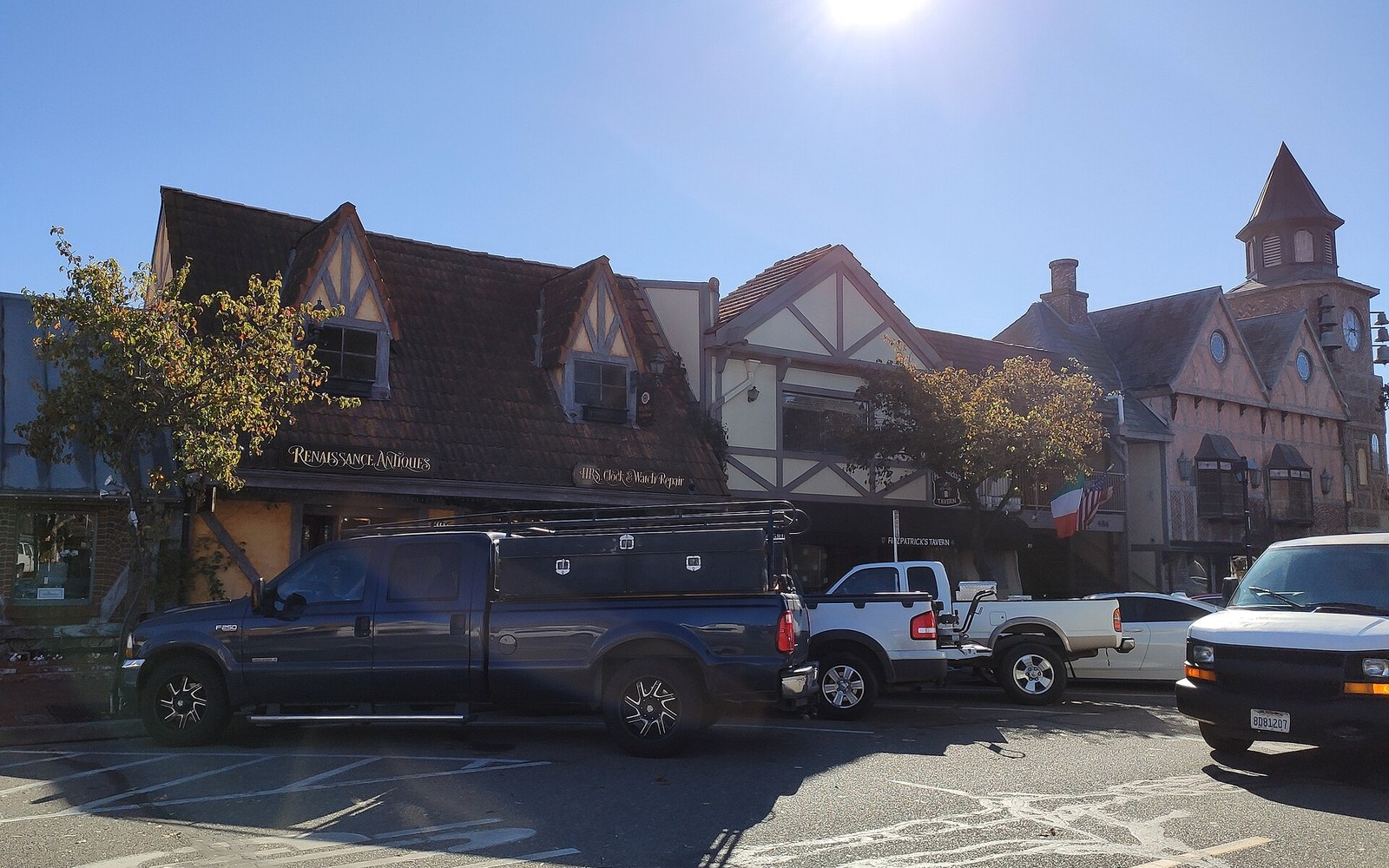
A grid built for foot traffic meets vehicles that need forty feet to turn
Solvang was platted in 1911 by Danish-American settlers who envisioned a pedestrian-scaled village, not a coach stop. The original survey established short blocks, narrow cross-streets, and a commercial core along what is now Mission Drive (Highway 246) that was designed around foot traffic and horse-drawn wagons — not the turning radius of a Mercedes-Benz Sprinter executive conversion or a 45-foot motorcoach.
That mismatch is the operational core of the Solvang drop-off problem. Mission Drive through the village runs as a state highway under Caltrans jurisdiction, which means curb access, loading zones, and any physical modifications to the roadway require coordination between the city and a state agency whose primary concern is traffic flow, not passenger egress. Parking is metered and timed along the commercial blocks; there is no dedicated TCP-vehicle staging area within the historic commercial core.

The practical consequence is that operators running groups into Solvang — wine-tour shuttles originating in Santa Barbara or Buellton, casino-adjacent transfers, and private charters from the Santa Ynez Valley estate market — must choose between a curbside stop that briefly blocks a state highway lane or a pull-out on a side street that puts passengers a full block or more from their destination. Neither option is clean. Larger vehicles, anything requiring a CDL and carrying sixteen or more passengers, face an additional constraint: the turn from Alisal Road onto Copenhagen Drive, one of the few interior circulation options, sits inside a block grid where the curb radii were never designed for a vehicle with a 50-foot turning circle.
Solvang's pedestrian tourism economy — which the California Office of Historic Preservation has recognized through the Solvang Historic District listing — depends on keeping the streetscape walkable and visually intact. That goal is structurally in tension with the volume of ground-transport demand the village itself generates. On high-volume weekends, operators report stacking on the Highway 246 shoulder east of the village center, a practice that puts vehicles on a Caltrans-controlled right-of-way without a formal staging permit and that the California Highway Patrol has authority to clear.
No dedicated ground-transport loading zone exists within the Mission Drive commercial core as of the most recent Solvang general plan documents. Until the city coordinates with Caltrans on a formal layover or staging solution, the drop-off problem is structural: a 1911 street grid will not bend to accommodate a vehicle class that did not exist when the village was laid out.